 | |
| Tay's icon on Twitter, https://twitter.com/TayandYou |
The topic of censorship has been one of great interest and controversy as of late, and it is a difficult topic to approach. On the one hand, we hold the freedom of speech to be an extremely important right in this country, and the sharing of different perspectives can create more thoroughly developed ideologies. On the other hand, our society has become very polarized, and discussions often just turn into screaming matches. Then you throw trolls into the mix, and all semblance of collective discussion to better everyone collapses.
The question becomes, when is it appropriate to censor others' speech? Some would argue that everyone should be allowed to say whatever we like wherever and whenever we like. But this carries its own problems. Even if you believe that everyone should have the right to say something at all, what if it is irrelevant to the platform or forum? Should someone be allowed to discuss their favorite programming language on a forum about oak trees? How and where do we draw the line? If some political opinions are allowed and some are not, who gets to be the moderator?
In general, the model is that you can choose what you say and the platform you use, and the platform will have its own rules about what you can and cannot say. "But wait, isn't that censorship? That's a violation of my First Amendment right to free speech!" This has been an ongoing debate on the Internet, as well as on our very own campus. Actually, the First Amendment only guarantees that the government will not censor your speech. If you use someone else's service, you are subject to the rules of that service. You have the option not to use that service. In other words, if Twitter had decided to shut down Tay's tweets or censor the bot's content, it would have been well within its right.
 |
| xkcd comic from https://i0.wp.com/imgs.xkcd.com/comics/free_speech.png |
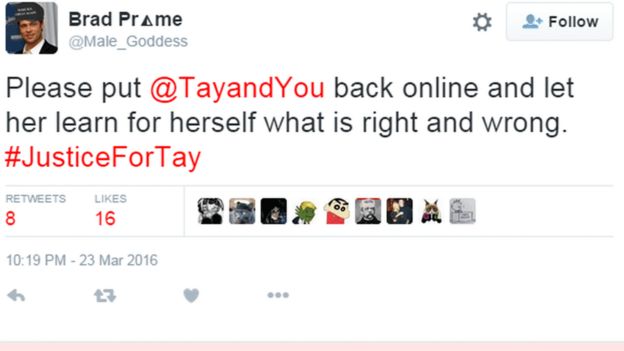 |
| Tweet screenshot from https://ichef.bbci.co.uk/news/624/cpsprodpb/4774/production/_88929281_taytweet2.gif |
Another problem must be addressed before this one can be fully discussed: It can be hazardous to allow a machine to learn by itself. A self-driving car, for instance, should not be allowed to run amok, arbitrarily deciding whether or not to hit people until it learns that hitting people is bad. Similarly, Tay spewing genocidal rhetoric could be harmful. Is it appropriate for Tay to go through this phase in order to learn right from wrong? Would it be more appropriate for an artificially intelligent machine to learn some basic morality in a simulation before being released into the world? Should all machines be preprogrammed with basic rules that prevail over anything else they might learn?
Unfortunately, I don't have any simple answers, but I do encourage a thoughtful discussion of these ideas. What do you think? When and where is speech appropriate or inappropriate? Should AI be allowed to create their own morality by learning from the world? Can AI create their own morality? (This is related to the original question, "Can machines think?")
Further Reading and Discussion:
- After Tay, Microsoft released another bot on Kik messenger that would explicitly avoid talking about politics. Is this a good solution, or would we like a politically aware AI chatbot?
- President Bahls's Statement on Freedom of Expression addresses the on-campus free speech discussion.
- Bitcoin's blockchain provides an effectively uncensorable platform for free speech (that nobody really reads, but if you want to, you can read plain-text messages here or download the whole blockchain and look through it yourself for other data). See this paper for more details on how this works. Is it good to have an uncensorable platform? Or is it too dangerous? Does it make a difference if nobody reads it? What about a tamper-resistant blockchain designed for storing data (or social media posts) like Steem where reading the blockchain is made easy and convenient?


