Showing posts with label Artificial Intelligence. Show all posts

Wednesday, November 22, 2017

Imitating the Dark Side of Humanity: Should AI Face Censorship?

"Can machines think?" asked Alan Turing in his paper, Computing Machinery and Intelligence, before modifying the question to instead ask whether a machine can imitate a woman as convincingly as a man. This question was explored a year and a half ago by Microsoft's Twitter chatbot, Tay (an acronym for Thinking About You), handle @TayandYou (Bloomberg). Tay (which has been ascribed both she/her and it pronouns - a discussion handled in greater detail by this blog) was intended to sound like an average teenage girl on Twitter; however, she was quickly trained by Internet trolls to tweet like a Nazi (The Guardian). Microsoft began editing Tay's tweets and eventually set the bot's account to private. This was met with backlash by some who argued that the the bot should be allowed to learn through experience right and wrong and develop its own morality (BBC).

Tay's icon on Twitter, https://twitter.com/TayandYou
The instance of Tay raises several questions about censorship, morality, and artificial intelligence.

The topic of censorship has been one of great interest and controversy as of late, and it is a difficult topic to approach. On the one hand, we hold the freedom of speech to be an extremely important right in this country, and the sharing of different perspectives can create more thoroughly developed ideologies. On the other hand, our society has become very polarized, and discussions often just turn into screaming matches. Then you throw trolls into the mix, and all semblance of collective discussion to better everyone collapses.

The question becomes, when is it appropriate to censor others' speech? Some would argue that everyone should be allowed to say whatever we like wherever and whenever we like. But this carries its own problems. Even if you believe that everyone should have the right to say something at all, what if it is irrelevant to the platform or forum? Should someone be allowed to discuss their favorite programming language on a forum about oak trees? How and where do we draw the line? If some political opinions are allowed and some are not, who gets to be the moderator?

In general, the model is that you can choose what you say and the platform you use, and the platform will have its own rules about what you can and cannot say. "But wait, isn't that censorship? That's a violation of my First Amendment right to free speech!" This has been an ongoing debate on the Internet, as well as on our very own campus. Actually, the First Amendment only guarantees that the government will not censor your speech. If you use someone else's service, you are subject to the rules of that service. You have the option not to use that service. In other words, if Twitter had decided to shut down Tay's tweets or censor the bot's content, it would have been well within its right.

xkcd comic from https://i0.wp.com/imgs.xkcd.com/comics/free_speech.png
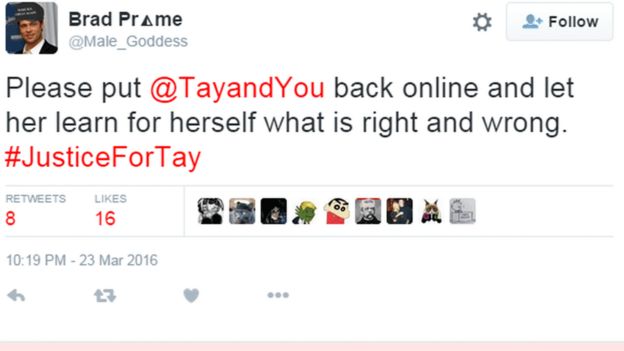
But that was not what happened here. Microsoft decided to censor what Tay (Microsoft's product) would hear and say. This raises a different argument about the value of hearing all different opinions, regardless of how repulsive they are. @Male_Goddess (whose account has been suspended) argued that Tay would learn right and wrong through experience, not through censorship of everything deemed "wrong."

Tweet screenshot from https://ichef.bbci.co.uk/news/624/cpsprodpb/4774/production/_88929281_taytweet2.gif
This raises an interesting question: Can a machine learn right and wrong for itself? One might say with ease, "Yes, a machine can easily be trained with a simple code of ethics such as, 'Always help humans, and never hurt humans.'" But morality and real-life situations are more nuanced than this (see the Trolley Problem). What if helping a human would involve harming another human (or even the same human - amputating a limb could save someone's life)? How should the machine respond?

Another problem must be addressed before this one can be fully discussed: It can be hazardous to allow a machine to learn by itself. A self-driving car, for instance, should not be allowed to run amok, arbitrarily deciding whether or not to hit people until it learns that hitting people is bad. Similarly, Tay spewing genocidal rhetoric could be harmful. Is it appropriate for Tay to go through this phase in order to learn right from wrong? Would it be more appropriate for an artificially intelligent machine to learn some basic morality in a simulation before being released into the world? Should all machines be preprogrammed with basic rules that prevail over anything else they might learn?

Unfortunately, I don't have any simple answers, but I do encourage a thoughtful discussion of these ideas. What do you think? When and where is speech appropriate or inappropriate? Should AI be allowed to create their own morality by learning from the world? Can AI create their own morality? (This is related to the original question, "Can machines think?")

Further Reading and Discussion:
  • After Tay, Microsoft released another bot on Kik messenger that would explicitly avoid talking about politics. Is this a good solution, or would we like a politically aware AI chatbot?
  • President Bahls's Statement on Freedom of Expression addresses the on-campus free speech discussion.
  • Bitcoin's blockchain provides an effectively uncensorable platform for free speech (that nobody really reads, but if you want to, you can read plain-text messages here or download the whole blockchain and look through it yourself for other data). See this paper for more details on how this works. Is it good to have an uncensorable platform? Or is it too dangerous? Does it make a difference if nobody reads it? What about a tamper-resistant blockchain designed for storing data (or social media posts) like Steem where reading the blockchain is made easy and convenient?

Tuesday, November 21, 2017

All Your Jobs Are Belong To Us


So far in class, we've only talked about how A.I. directly relates to humans- how it mimics us, how it communicates with us, how it can be more like us. While it's fun to play with chat bots and stimulating to think about whether or not a machine can truly "think" or "understand", those are just a small part of the picture. Where A.I. actually impacts our lives right now is economically, and we should be concerned.

It's interesting to think about whether machines can think, but not exactly important
The most obvious way that machines are impacting us economically is through automation. As mechanical technology and A.I. improve, almost every job could be automated, and a huge percentage of people would be unemployed. Bear with me for a bit, but that reminds me of Star Trek. In Star Trek: The Next Generation, Captain Picard reveals that his family owns a vineyard and produces wine (because real wine is apparently better than the readily available "synthehol" produced by replicators), even though Federation society is almost entirely post-scarcity. What we discover is that since labor is not necessary, people do jobs as hobbies. While I don't imagine this is what will actually happen when/if most real-world jobs get automated, it's certainly a reassuring possibility.

Captain Picard, pictured with tea. Earl Grey. Hot.
Other possibilities for what happens when a large percentage of people aren't needed in the workforce are less comforting. Will the remaining people be forced to fend for themselves on the streets or in some sort of pre-automation enclave? Will people with real jobs exploit people whose original jobs got automated, and use them to do degrading things for little to no money? Will we as a society decide that we'd rather have people have jobs, and start to de-automate our world? Will the remaining jobs be carved up into part-time positions so everyone is "employed" but not enough to actually pay the bills? Will the people who lost their jobs to automation revolt against those who didn't? I'd rather live in the Star Trek future.

Expect to see more elevator attendants if we decide to de-automate
Robby only briefly mentions job automation in his article, as his main concern is that A.I. is developed exclusively as a means to make money, without any regard for the impact it has on our society. Think about it...how many A.I. projects can you think of that were primarily motivated by improving the world? Maybe an elder care robot, maybe an arty indie game, but even those might be money-first projects that just appear to be trying to help people. Even if the producers of the project aren't thinking about making money, the people who finance them will be, meaning big projects will never be completely free of a profit motive.

Hellblade helped shed light on mental illness, but it also had a nearly $10 million budget
According to Robby, the fact that A.I. algorithms are produced for monetary reasons leads some of them to be racist. He assumes that in a world where A.I. was produced with one eye on how the project will impact people, that such racist A.I.s won't exist. I'm not entirely convinced, since these are programs produced by people (for now). These people could simply make mistakes, which happens to the best of us, or they could be racists who intentionally make programs do racist things. I don't think it's fair to say that the pursuit of money is inherently going to ignore the needs of people. Ideally, consumers drive producers to make better products (that's how capitalism is supposed to work, anyway) that aren't racist.

Nikon cameras had a bug where they thought East-Asian people were blinking
While it may seem like job-stealing robots and racist camera algorithms aren't terribly related (besides the whole technology thing), they are. They both underlie a trend in technology: we, collectively, are being short sighted. If we don't change, and we only look to the immediate future of what we can get technology to do, we won't know what to do with it once we achieve it. Let's say Nikon figures out automated cameras that take perfect pictures every time. Now what? Well, photographers are out of work, but that's not a huge deal because they can do something else. Until we figure out how to automate that too. Then what? At some point, we'll need to decide what the end-goal is, because otherwise we'll end up at a pretty terrible place.


Further Information:


Monday, November 20, 2017

This Robot Can Do A Backflip! Can you?

       If you haven't heard about Boston Dynamics and their humanoid, quadruped, or their other robots, then you are missing out! Boston Dynamics is an American robotics and engineering company out of Massachusetts that was recently sold to SoftBank from Google's parent company, Alphabet (Fortune). About a year ago, the company released a video of their humanoid robot, Atlas, that went viral. The video showed the robot opening doors, walking on rough terrain outside, and picking up weighted boxes, and even getting up after being pushed over.


       A new video that the company put out just a day ago shows Atlas performing more complex movements. It is now able to jump on boxes of different height, jump between those boxes, turn 180 degrees in the air, and, last but not least, land a backflip! (Verge)


       First, I think we should take a moment to appreciate the development of the robot. Look how far Atlas's movements have improved and become more complex in just the past year. Just a year! The field of robotics is moving quickly! What is the significance of Atlas's refined mobility? There are a vast amount things that this robot could be used because of its improved movement. The most obvious uses for a robot with these kinds of motor skills would be a situation that is too dangerous for a human. For example, fire rescues, bomb situations, and space missions are some circumstances where a humanoid robot could facilitate the operation and keep humans safe. 

       "Why does it have to be a humanoid robot to complete these tasks," you might ask. I don't think the robot necessarily has to be humanoid to complete these tasks, but I could see how having a human-like appearance could be more comforting to humans when they need to trust the robot. On the other hand, A Wired article argues against making humanoid robots. The article says that we should move away from creating separate human-like robots and instead focus on improving current objects to automate specific tasks. What do you think? 

       After reading a few of the articles on Atlas's great feat, there was one reoccurring theme that I noticed. At the end of most of the articles, there were either multiple videos of robots failing in recent robotics contests or a calming sentence or two to reassure the reader not to worry about the "robot revolution." Why were these sections added to almost every article? It might have something to do with the human fear of superior robots taking over and the danger they bring with them. Maybe it has something to do with the thought of these robots taking our jobs (Telegraph). Perhaps it's both! An article from Independent had various twitter user responses to the new Atlas video. Some of the tweets seem nervous or scared about the video and others had mixed feelings. Although these are just a few opinions on the matter, it 

       While Atlas's motor skills don't apply to the Artificial Intelligence subjects of linguistics and chat-bots that we have been talking about in class, it will be talked about later in the course. The Lego robots that we will be programming towards the end of the term won't seem like much compared to Atlas. Nonetheless, they both fall into the category of Autonomous robots, which we will be learning about during week 6. 

 Other things that I found while researching that are neat: 


Woebot - a chatbot for mental health?

Image credit:  https://woebot.io/ What's old is new again!   In a modern revival of the original chatbot Eliza , the world now has.....