Sunday, February 18, 2018

Woebot - a chatbot for mental health?

Animation of Woebot standing with open arms
Image credit: https://woebot.io/
What's old is new again!  In a modern revival of the original chatbot Eliza, the world now has...  "Woebot"

What do you think?  A cheap gimmick, or an effective substitute for some people, in place of meds and expensive counseling sessions?

Quoting from their website:
In a recent study conducted at Stanford University, using Woebot led to significant reductions in anxiety and depression among people aged 18-28 years old, compared to an information-only control group. 85% of participants used Woebot on a daily or almost daily basis. You can read the entire peer-reviewed study.

If you're feeling depressed or anxious, do you think talking to Woebot could improve your frame of mind?

Saturday, February 10, 2018

There's Still Time to Find Love!

Because I stumbled upon some weird tweets tonight and in honor of Valentine's Day in a few days, I thought I would share these humorous but thought-provoking posts.

A research scientist named Janelle Shane trains neural networks, as stated in her "About" section in the links below. She's revealed a few of her projects, including a neural network framework that produces pickup lines and her most recent creation, "Candy Heart messages written by a neural network."

In her "About," she says she trains neural networks to "write unintentional humor as they struggle to imitate human datasets. Well, I intend the humor."
How romantic.
She also does other cool stuff with Pokémon and recipes, and has been written about before (this article discusses a neural network she trained to tell knock-knock jokes), among other things.


Friday, February 9, 2018

Is AI biased?

When it comes to AI technology there are many concerns that we all think of. One concern that we may not often think of, however, is bias. One familiar case of biased AI is the case of Microsoft's chatbot, Tay. Microsoft released its twitter chatbot, Tay, in March of 2016 and within 24 hours the bot learned to use misogynistic, racist, and antisemitic language from other twitter users. However, the bot sometimes gave mixed responses. For example, when the topic of "Bruce Jenner" was tweeted at Tay, the bot responded in mixed ways ranging from praise for Caitlyn's beauty and bravery to entirely transphobic responses. But what if biased AI goes beyond the occasional chatbot?

The biases in AI unsurprisingly often comes from biased data. Since AI is designed to improve and become more accurate the more time and data it is given, it is not surprising that when given biased or faulty data the AI often produces results that enhance, inflate, and amplify that bias. For instance, when given a set of pictures that were 33% more likely to show woman cooking rather than men cooking, the AI predicted that women were 68% more likely to be shown cooking in the photos.

The answer seems to be simple, remove the bias. Train the AI with good quality data. The challenge, however, crops up in the "unknown unknowns" or the missing areas in the data that are not easily recognizable. For instance, when AI is given pictures of all black dogs and white and brown cats for training, when it comes to testing data the AI will incorrectly identify a white dog as a cat. It seems easy to catch this mistake with an AI that discerns pictures of dogs from cats, but catching this mistake becomes even more difficult in real world situations, especially when the AI is convinced that it is right.

(image source: https://www.theregister.co.uk/2017/04/14/ai_racial_gender_biases_like_humans/)

AI learning biases against certain groups may at first seem harmless to some, especially when considering low stakes situations such as identifying cats and dogs. The stakes become extremely high very quickly when AI gets involved in heavier matters such as the courts system. In May of 2016, a report showed that an AI program, Compas, used to determine risk assessment for defendants was biased against black prisoners. Compas wrongly labeled POC as more likely to reoffend at nearly twice the rate of white defendants. Another example is the first AI to judge a beauty contest, in which it chose predominantly white faces as winners. Or the LinkedIn search engine that suggests a similar looking masculine name when one tries to search for a contact with a feminine name.

So, what can we do? First off, we can be more mindful of the data we are using to train our AI. Paying close attention to details such as where the data comes from and what other biases and factors may shape and form said data can tell us many important things. We can also make an active effort to reduce biases within AI by joining or forming groups such as Microsoft's FATE (Fairness, Accountability, Transparency and Ethics in AI). We can also form and support groups and initiatives that encourage those of marginalized groups to join the field of AI. Furthermore, we can put an emphasis on developing explainable AI. There is already a vast amount of confusion and potential for slips with training data alone; adding more confusion with "black box" only exacerbates the problem and makes it more difficult to identify the source of the problem with biased AI.

With AI being implemented more frequently to help predict various elements from many facets of daily life, from loans to health care to the prison system, it is more important now than ever to understand how AI can inflate and exacerbate biases that are already present. It is not only our job, but our responsibility to understand how these biases may affect the lives of many and, hopefully, devise ways to adjust for these biases and skewed results accordingly.

“The worry is if we don't get this right, we could be making wrong decisions that have critical consequences to someone's life, health or financial stability,” says Jeannette Wing, director of Columbia University's Data Sciences Institute.

The technology we develop can have a vast impact on many lives. It has the potential to become the way of the future. Shouldn't we take the time to assure to the best of our ability that this technology doesn't further hinder, but rather facilitates the success of those who need it most?

Feel free to share your thoughts below. Should we be concerned about biased AI? What ways should we focus on diminishing this bias? Is AI bias shaped more from data or the AI itself? Would AI sentience/awareness affect this issue and our response to it?

If you would like to read more about Microsoft's chatbot, Tay, you can do so here.
If you would like to read more about Compas, click here.
Here you can read about the LinkedIn search engine.
You can read about AI bias and possible responses more in depth here.

A.I.’s role in Space Exploration

The use of A.I. technology in space exploration isn’t new. It actually dates back to 1998, when the comet probe Deep Space 1 was flown into space by the A.I. algorithm Remote Agent. Also, while autonomous driving systems are currently making a fuss on Earth, the technology has been in use on Mars since 2004 as AutoNav (the autonomous driving technology) has powered Spirit, Opportunity and, more recently, Curiosity rovers. These rovers are driven by an A.I. algorithm called AEGIS that intelligently chooses photo targets allowing scientists to explore areas of interest.


And now, with further advancements in A.I., NASA is already seeking to expand its role. They already have plans in place for the Mars 2020 rover as well as the Europa Clipper that will explore whether Jupiter’s icy moon Europa harbors conditions for life. It will be interesting to see how long these missions last, especially on Europa, where the probe seeks to penetrate 10 km beneath the ice crust, and communication to and from Jupiter gets even more limited.


These projects are definitely milestones for A.I. Especially as we are working on the robot maze project, I can only appreciate how these algorithms navigate the rovers through various obstacles like rocks, dents, and sand dunes, while simultaneously communicating information back to Earth. As it travels on Mars’s surface, it collects more information about its world, which seems like a more complex and larger version of our project.

While these missions are ambitious, I am also intrigued how far scientists are willing to go? Will this eventually lead us to extraterrestrial life forms? If we indeed find another planet that supports life, who owns it? With superpowers like China and USA competing for supremacy in AI, will this be the start of another space race?


Related interesting articles


Wednesday, February 7, 2018

Can quantum computer really help AI?

       In this article, I will discuss about the effect of quantum computer possibility on the future of AI. In particular, the topic of this discussion will be on weak AI (Machine learning). Based on several estimations, 2.5 exabytes of data per day is generated by us. That’s equivalent to 250,000 Libraries of Congress or the content of 5 million laptops. Every minute of every day 3.2 billion global internet users continue to feed the data banks with 9,722 pins on Pinterest, 347,222 tweets, 4.2 million Facebook likes plus ALL the other data we create by taking pictures and videos, saving documents, opening accounts and more.
Image Credit: posteriori / Shutterstock.com

      This amount of data is so big that even most recent chips and processors are still falling behind the pace of processing and analyzing all these high dimensional data. While Moore’s Law, which predicts the number of transistors on integrated circuits will double every two years, proved remarkably resilient since the term was coined in 1965, those transistors are now as small as we can make them with existing technology. That’s why there’s a race from the biggest leaders in the industry to be the first to launch a viable quantum computer that would be exponentially more powerful than today’s computers to process all the data we generate every single day and solve increasingly complex problems.
      I have attempted to find several good resources for starting with quantum programming. QISKit (Quantum Information Software Kit) is a software development kit (SDK) for working with OpenQASM and the IBM Q experience (QX). You can use QISKit to create quantum computing programs, compile them, and execute them on one of several backends (online Real quantum processors, and simulators). I think this is really cool and I have installed them by traditional Python command prompt. They have several tutorials that you can follow to understand the principles behind the scene.
     I think that quantum computer is getting more and more attention from the general public as well as funding. In 20 years from now, I think that quantum programming will be a very important factor of the development of AI as it can fundamentally change the way how we parallel training or parallel searching.

Sunday, February 4, 2018

A.I. Sports Betting

With today being Super Bowl Sunday, I couldn't help but think about how A.I. might be involved with the betting. We have seen artificial intelligence as a player in games such as chess, Connect 4 and our penguin game from class. What about artificial intelligence as an observer that predicts the outcome of a game? This is all made possible through the availability of competitor statistics and what is called swarm intelligence.
image: http://moziru.com/images/drawn-ant-ant-colony-2.jpg
Some areas where A.I. is making an impact in the betting world is in football, soccer and horse racing. You can read more on the betting and swarm intelligence here: https://www.digitaltrends.com/cool-tech/ai-swarm-intelligence-and-the-future-of-sports-betting/

One company that is involved in sports betting, Unanimous A.I., correctly predicted a superfecta in the 2016 Kentucky Derby. A superfecta is when you pick the top four finishers in a race in the correct sequence. Couldn't just be completely luck, right? Currently, Unanimous A.I. has made some predictions for Super Bowl LII today, which can be viewed here: http://unanimous.ai/super-bowl-52/.

Example of prediction interface of Jaguars vs Patriots on 1/21
gif: https://files.digitaltrends.com/images/KjCbtN8.gif


Another company, Stratagem, is focusing on soccer, basketball and tennis. You can read more about Stratagem here: http://www.stratagem.co/about/. These companies still utilize human resources to help with gathering data--with most of the difficult analysis being done through deep neural networks.
image: https://encrypted-tbn0.gstatic.com/images?q=tbn:ANd9GcQKWhfcbquKC5iTD9e5vBUp9sTmORLo0HbICye0epL1jIHVZ-c4
This leads us to the question of how will artificial intelligence impact the future of betting and what role will it play in predicting the outcome of events? I think we still have time before the betting world becomes fully automated. Right now these technologies are giving an edge to those who utilize them. Will betting institutions prohibit the use of technology like this? In what ways could they even know you are using A.I. to place your bets? Lots of people make a living off betting, and I wonder what sort of impact these predictive models will have on that area.

Thursday, February 1, 2018

Wearable Technology: Why Are We Not On Board?


How many people do you know who employ some sort of wearable technology in their daily lives? The Apple Watch, the Fitbit Ionic, Motiv Rings, and the like are truly a new and exciting step in the implementation of computer technology in fashion and all aspects of our reality. Or at least that was the initial forecast back in 2015, when eMarketer anticipated smartwatch sales to increase by 60% the next year.

Though, in a more recent article, eMarket makes it clear that consumers have consistently shrugged off the significance of wearable technology. The 2015 forecast missed the mark by an enormous margin, and continued to disappoint the manufacturers for the next three years. The percentage increase in smartwatch tech consumption could be down to single digits by 2019, and most of the consumers are those who already own similar technology. The American public are not buying wearable technology, neither with their money nor as a "revolutionary" concept.

The article speculates cost as the main deterrent. The net benefit to one's daily life does not justify the price tag. However, at the end of the day, maybe society is simply not that interested in incorporating more technology into everyday life past the comforting external quality of the smartphone. Or, perhaps as the tech gets closer to the skin, it is assumed a more severe dependence might form. This possibility is haunting.

Thad Starner (2nd from right) and the MIT "Borg"
Though, according to those who have advocated for wearable Tech and AR (Augmented Reality) tools since their nascent stages, it does not so much challenge our humanity as enhance it. Thad Starner (above), possibly the very first individual to consistently explore and utilize wearable technology, has a remarkable story to tell in this sense. 

Recently interviewed on an episode of the popular NPR podcast "Invisibilia," Starner explains his journey to creating LIZZY, his wearable AR system, in 1993. He wore the get-up, consisting of a lead acid battery, a modem connected to a car phone,  a twiddler keyboard, and a tiny screen jerry-rigged to some glasses, for 20 years. Every single day. He developed with his friends (other MIT geeks called "the Borg") the Remembrance Agent, which is essentially augmented memory. It allowed Starner to query the information he had entered into LIZZY over the years, displaying it on his screen without distracting from a conversation or class. Besides needing to charge the device, and setting himself on fire once when initially designing it, Starner says the device is indispensable. He corroborates this in an article for engadget.com, in which he goes into even more detail about his LIZZY system and its effects on his life.

"You're really trying to make interfaces that allow people to augment their eyes, ears and mind, but not get mired in the virtual world." - Thad Starner on developing AR technology, engadget.com

A healthy balance of reality and virtual reality. Thad seems to have it figured out. So what's wrong with everyone else? Why is no one leaping at this phenomenal chance for endless memory and a google search of your own thoughts to share with the world? One possible reason is that the wearable tech we have right now is a diluted version of Starner's design. It lacks the intimacy he has allowed it, giving the device responsibility to manage all of his information and deferring to it automatically. Therefore, it lacks the utility he so very much enjoys.

Take, for example, Google Glass. Remember Google Glass? Me too, barely. It was a major flop. In this article describing five reasons the ill-conceived device was a disaster, the most damning piece of evidence is that it had no clear function. It could take pictures and give immediate access to the internet. But phones already accomplish that, and don't feel like you are lugging a barbell around on the side of your head. A $1,500 face barbell. That isn't nearly as sexy as a bottomless memory bank. However, one of the heads of development for Google Glass is the original cyborg himself, Thad Starner. He couldn't replicate LIZZY on a large scale due to its slightly invasive nature.

Certainly no one can argue the utility is incredible. It transcends the difference between having access to something that has an ability, and simply having the ability oneself. Though that transparent nature is what is truly unsettling. If we could input a chip into someone's brain that could run any an A* search method, or run a minimax algorithm to make decisions in a game like connect4, would you prefer those operations run automatically? Like a sharp intake of breath resulting in immediately finding an optimal path? Otherwise, it is the equivalent of having an apple watch or other wearable device that requires tedious manual input. Without surrendering some element of ourselves, we may never be able to unlock the full potential of these devices.

This form of Artificial Intelligence poses so many questions because it is the first step in contemplating our society's maturity level in dealing with human/technical relations. It is not a discussion of manufacturing new consciousness. It is a discussion of building off of our own current consciousness. Incorporating technology into our own psyches on an individual level now could reflect how we will react when we incorporate technology into our society on a grand scale. 

So perhaps the public's apprehension to adopt wearable tech, cyborg implants, or other forms of AR tech goes beyond the price tag.  Current AR technology is representative of what we discussed during the debate regarding consciousness. If we ever come to a point where we can give AI consciousness, perhaps we should think better of it. It might simply stunt AI's utility. Similarly, AR companies have thought better of offering something like LIZZY, and even if they offered it, would the public be forward-thinking enough to open themselves up to such an intimate relationship with any device? If we do so, would we have accomplished Artificial Intelligence by using our own current intelligence as the core and adding an artificial component? Would you be willing to take such a leap?

BONUS:

Pete Holmes comedy bit about the role of technology in our lives


Photo credit:

Smartwatch Photo: https://newsroom.cisco.com/feature-content?articleId=1840876&type=webcontent

Thad Starner: https://www.engadget.com/2013/05/22/thad-starner-on-google-glass/


Thursday, January 25, 2018

Automated Grocery Stores, Coming to a Neighborhood Near You!

Automated Grocery Stores, Coming to a Neighborhood Near You!


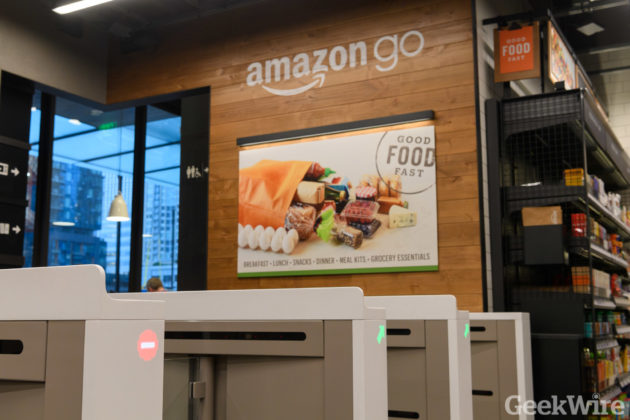
On Monday, January 22nd, the first automated grocery store opened in Seattle. Amazon Go, opened its doors to the world with an (almost) fully automated store. With having only a handful of employees to prepare food in the kitchen and to verify ID's for alcohol and tobacco-related purchases, the store is fully independent of having human workers.

The opening of the store was originally to be December 2016. With such a delay, Amazon explains that it took time to train their machine-learning algorithms that are also coupled with the concept of computer vision.


Now, at this point in reading into the store, I began to wonder...How does a fully automated grocery store even run? What is the check-out process like? What's implemented into the store to prevent shoplifting?

Well, upon further reading, I found that the store requires every shopper to log into their Amazon account, and download an 'Amazon Go' app. Then, through the complex algorithms implemented into the store, whatever items you bag and take with you, you will then be billed accordingly to your Amazon account. Another thing that I found fascinating is that the algorithm within the store is advanced enough to be able to determine if you are bagging an item to take with you, just picking up an item to read the label/nutrition facts, and if you end up setting the item back in another location in the store! Additionally, even if somebody tried to shoplift the store, the algorithms are precise enough to detect it, and that individual would be billed accordingly.

To me, this idea of automated grocery stores is very intriguing! Especially in regards to Amazon's machine learning and computer vision algorithms that are implemented within the grocery store. I think that this concept will be a start of a new chain of grocery stores (powered by Amazon too, no doubt). What do you guys think about this automated store? Do you think that the Amazon Go store will become the next local super-store? How do you think the machine learning algorithms implemented in the store will affect A.I. development in general?

Photo Creds:

Sunday, January 21, 2018

Money making AI with Steem

Steem is a Crypto-currency that is being used as a social media platform. It is light, fast to transact, and requires no fees to move funds. It is being used by the developers at the website called Steemit.com. The biggest feature from this project is that on Steemit the users create content and up vote others. The users are then given rewards that are generated from thin air on this platform.


Now that is obviously an over simplification of the platform but this blog post if not about a Crypto-currency. The point I would like to focus on are the rewards that are given to the users. There are two ways to make money from content.
1: If you create a comment or post that someone likes they can up vote you, the up votes all have different values depending on how much stake that user has on the network. But for every person who up votes you who owns Steem, you make money.
2: If you up vote posts and they then become popular then you get rewarded for finding good content for the network.

Now there is an API for Steem that allows you to automate anything with the network. You can automatically post anything on the network using a bot, you can also up vote using a bot. If you can create an algorithm that finds good content that gets up voted you can constantly collect rewards from the network. But it is really hard to read a picture, link and text to identify if content is enjoyable.

This blog post looks at some of the most famous bots on the network. I will show a couple of examples from this blog post, but if you are interested there are some very cool stories and posts on this blog.

The algorithms can be very basic or very complex. Some will analyze which posts get up voted, see how long each post is and how many photos are included. Now scan the block chain to see similar posts with the same length and number of photos and up vote all of them!

Here is a bot that just monitors accounts and up votes every article the user posts. Another bot tries to catch plagiarism in posts and report them.

Now this might seem a little off from AI, and I agree. Creating a bot that just up votes something everyday or just uses pure randomness is not AI. But going back to our assignment in class, NLP, we would analyze text and identify if it is positive, negative or neutral and rank the statement. A good example of a bot that is doing this is this bot. The AI looks at posts and ranks them depending on several parameters mentioned in the post. I also believe that this space is very new considering Steemit was introduced in 2016. Machine learning and other AI could be used in this space to try to understand what people enjoy. Since everything is open sourced it makes it easy for developers to interact with the block chain and users to see how information is received by the community. We could use weights to identify if a certain length of article keeps the user engaged but not too short/long. We could weigh the number of photos or the topics that are presented in the post.

Now this sounds really interesting, thousands of posts a day, earning a millions of dollars, up votes small communities of great writers. But this creates a weird ecosystem. You start to have huge bots who are up voting content. These bots start deciding what content looks good and what you should see at the top page. If you start creating content you can target these bots to reward your content. If you understand the algorithm and exploit it you can get hundreds of bots to up vote every single piece of your content. People will start writing blog posts to appeal to bots instead of humans, and people are trying to upvote what bots will upvote. This system can get to a point where bots are just fighting with eachother over content and the enjoyment of humans is put on the back burner. YouTube uses similar practices, but they have an end quote of getting the most ads in front of you. These bots have an end goal of using the system to guess which post will be best. If they dominate the humans on this platform they could be the audience that we perform for to make Steem.

But the Steem community calls themselves the "Proof-of-brain" Crypto so perhaps this will never be the case. But it is a very interesting space to try to understand the content that will be produced and received by a bot community.

Disclaimer: I am not trying to encourage anyone to buy Steem, I just want to show some cool things that are happening in the space.

Sources:
Screenshot of steemit.com curtosy of Daniel Zwiener
Second photo is from bitcointalk.org or found at http://empowereddollar.com/wp-content/uploads/robot-accountant.jpg

Universal Basic... Jobs, anyone?

good job blue ribbon
[image license: public domain]


Last class period we briefly discussed the question of...

If advanced A.I. takes everyone's jobs (except perhaps a few super-wealthy CEOs and presidents of the robot companies & robotic factories that are self-contained wealth-production machines), then... what?

Someone mentioned UBI (Universal Basic Income) as one possible solution, and some people have been promoting this idea for several years (NY Times article from 2016).  However, there are also a variety of potential objections to it.

An A.I. mailing list that I read posted a link to this article that proposes "Universal Basic Jobs" as an alternative to UBI. 

I don't know if this idea would work, but it caught my interest.  What do you all think?  (Let's discuss in the comments below!)

Thursday, January 18, 2018

AI beat human in Stanford reading test, NLP breakthrough?


Credit: Jack Ma, CEO of the Alibaba Group (Koki Nagahama/Getty Images)
The ability to read is truly a huge evolutionary advantage for humanity. With written language we can retain and retract knowledge, passing it down for generations. The ability to write and read is the heart of human development over the last millennium. The AI industry has long sought to develop machines that possess this ability. In a recent article, Alibaba's AI Outguns Humans in Reading Test, Alibaba and Microsoft’s AIs have made significant progress in machine reading, beating the human average score in the Stanford reading test. This test based on more than 500 Wikipedia articles, and designed to figure out if AIs can process through a large quantity of data to answer the questions set. Both AIs, for the first time in history, score a higher score than human average. This mark a big step in Natural Language Processing development. According to this article, Microsoft acquired Maluuba, a company that uses deep learning to develop natural-language understanding, around this time last year, and has since then placed focus on making literate AIs. It’s amazing how in the article, which written last May, the co-founder of Maluuba still only hope to make the literate machine, and now they have developed AI that can surpass the average human score in a reading test. For Alibaba, they already apply this technology on Singles Day, the world's biggest shopping bonanza, by using computers to answer a large number of customer service questions, according to this article. It’s clear that research in literate AIs are growing quickly, and will soon be able to provide us much benefit.

Scoring higher than human on a test does not prove AIs reach a human reading comprehension level, however. We as humans can detect nuances, hidden message, sarcasm, etc. in reading, but these AIs still very impressive in their own right. The AIs clearly open many possibilities, including processing a large amount of data and making sense of it. Customer service, healthcare, virtual assistant, search engine, etc. all will benefit from this. If we keep this development rate, I think we can create AIs that hold all humanity digital knowledge and can answer any question with precise accuracy in the next 50 years. However, this technology also has flip side. Now AIs could potentially understand human communications, malicious AIs could potentially spy on a large scale, and make it easier to obtain valuable information without us noticing. Also, in development of new know-it-all AIs, if we not careful with the data we feed the AIs, the AIs knowledge could potentially get manipulate, just like how the Microsoft's twitter AI Tay eventually got shut down due to her access to uncleaned data.

This breakthrough is clearly related to our class Nature Language Processing topic at the beginning of the term. In class, we learned how machines can try to understand and process written language by parsing and using sentinel score. We also talk about how the technology available still cannot completely let machine understand language well because of the ambiguity of language. However, it seems like we are coming nearer and nearer to that goal. Of course, Alibaba and Microsoft’s AIs are using deep learning and not simple code we use in our politician analysis assignment, but we can hope that this technology will soon be accessible to the public. What a great time to be learning about AIs, when we can see the technology evolve day by day.

I’m excited to see new technology like this helping people in their life. However, I also concern about how this could affect our job market, as now AIs could potentially continue to replace human in the workspace. I'm also wondering if after making AIs that could inherit our current knowledge, could we start making AIs that create new knowledge, and should we do such thing?

Tuesday, January 16, 2018

Can AI Be Used to Read Minds?

(Source: http://www.hindustantimes.com/tech/scientists-develop-artificial-intelligence-that-can-read-your-mind/story-drSQCLm7CXUbXbqkoJ28SN.html)

How would you feel about a computer being able to read your thoughts? While mind reading robots might seem like a fairytale of the future, it might become a reality as four Japanese scientists have begun to reconstruct images from people's brain patterns (article). For their experiment, scientists would show test subjects various images of animals, people, letters, and geometric shapes. They would then measure the subjects' brain activity while they were looking at the image or in other cases they would ask the subjects to recall a previously shown image from memory. Afterwards by using machine learning algorithms, a computer would take the brain measurements and decode the information to recreate the image the subjects were seeing in their heads (see example images below). The technology isn't perfect, however, as it only gives a rough outline of the object in the picture and appears to lack the finer details making it hard to tell what image the subject was looking at. One problem is it is harder to decode brain signals when a person is trying to recall an image versus when they are looking at the image because a person’s memory isn’t as good at remembering all the details making it harder for AI to recreate the image. (For more details check out their research paper)
(Source: https://www.cnbc.com/2018/01/08/japanese-scientists-use-artificial-intelligence-to-decode-thoughts.html)


Assuming we are able to create mind reading robots, that opens the possibility to do lots of cool things like controlling robots using just our mind or allowing people with speech problems to still communicate by speaking telepathically through a computer. Consequently, there are also a lot of problems that could come from mind reading AI especially with the issue of privacy. Many people would probably feel uncomfortable with the idea of a robot reading their thoughts and feel more self conscious about what they are thinking. The technology could be abused by advertising companies who might try to read a person's thoughts as they already are tracking people's browser history to determine what kind of advertisements to send them. Mind reading robots would also likely be used by intelligence agencies to help prevent violent crimes but at what cost? Are people willing to give up their privacy to be safer? My guess is no, based on the backlash the NSA received for collecting internet and phone data. If mind reading robots were created there would have to be some sort of laws put in place to protect people's privacy to prevent others from taking advantage of the technology.

Relating to class I think this article shows us the real life possibility of what happened in Chapter 5 of iRobot where the robot Herbie was able to read minds and speak telepathically. While I do not think we are close to having robots like Herbie who can read a person’s every thought, this is a stepping stone towards that future and offers us a better idea of how the human brain works. I think this can help scientist create smarter AI and maybe even conscious AI that can act like humans through recreation of human brain activity. Of course this depends on whether one believe AI can even become conscious or if it is purely a human trait. Do think it will be possible for us to be able to completely understand the human brain and create a mind reading robot like Herbie or a conscious robot that can think similarly to a human? 

Sunday, January 14, 2018

Artificial Intelligence in Medicine

One of the most important parts of a functioning society is the access to quality healthcare for life expectancy to be longer and to improve the overall healthiness of a population. Also, naturally, people want to help each other live longer and enjoy their lives with the least amount of physical suffering possible. So, of course in a field with such large ramifications towards the well-being of a population, the most advanced technologies are going to be developed oftentimes geared towards advancing medicine in some form or another. A.I is no exception to the rule and there have recently been fairly large advances in technologies capable of improving healthcare in the future.

Perhaps one of the most prominent examples of this is IBM's Watson - and particularly the Oncology diagnostics. IBM Watson makes recommendations that have a 90% concordance rate with the tumor board recommendations (See their full Oncology section here). This means that rather than waiting for another human doctor to spend time reading images and then getting back to the original doctor in order to corroborate ideas, the original doctor can rely on Watson to achieve the same goals but much much quicker. This efficiency is extremely important in a field like Oncology, because the earlier treatment starts, the better odds patients have at full recoveries. Watson uses a lot of similar techniques that we have been learning about to analyze different types of data or apply its A.I. to areas beyond Oncology specifically. From advanced natural language processing to machine learning in order to most successfully grow and achieve whatever its given goals are by IBM.

A second major example of A.I. influencing the world of medicine is the DeepMind research based in the UK. DeepMind focuses on A.I. that can learn to interpret test results based off of previous similar results and recommend a treatment plan or diagnosis through this learning. Probably the most obvious benefit of this is again the speed at which an A.I. will be able to return results to patients or the primary doctor versus waiting on multiple doctors to all agree on something. Speed at which treatment starts in medicine is arguably the most important part of the field, so using A.I. to greatly improve speed will be a huge leap forward in the quality of care for most patients. See more about DeepMind's own goals here

I wanted to talk a bit about medical advancements within A.I. because it is a pretty similar topic to the transhumanism debate question (or at least moving in that direction), because I think one could easily see this moving away from even needing to go to a hospital to receive a diagnosis and instead having some kind of device on you or attached to you that would immediately alert you to some sort of negative change to your bodily health. I think this is a pretty interesting concept that could really positively influence the world of medicine so I'm curious what you all have to say about it.


Here is a quick video of the cancer center heavily involved in trying to utilize IBM's Watson:

Thursday, January 11, 2018

A.I. Is Now Somewhat Capable of Creating Fanfiction

Photo taken from Botnik's Harry Potter post

As A.I. advances, we see new forms of content being created.  One of my more recent favorites is fanfiction that is being created with A.I.  In particular, a company called Botnik Studios is working on a predictive writer that can analyze content and output new content in the same style.  I originally stumbled upon this creation on Tumblr, but as it turns out, there have been quite a few websites covering some of Botnik's works.  In particular, a website called The Verge wrote an article called This Harry Potter AI-generated fanfiction is remarkably good, and just as the title says, it is remarkably good for what A.I. is today.

Thus far, Botnik has created predictive keyboards to write new lyrics for specific bands, facts about animals (which of course are probably not true, but sound like they could be true), cooking recipes, TV episode scripts, romance related topics, advertisements, holiday related topics (tips, history, and songs), poetry, book narrations and dialogs, video game tips and titles, tech reviews and quizzes, among other miscellaneous topics.  Botnik has a page of all available predictive keyboards here if you would like to play around with any.

From this technology has spawned quite an interesting chapter of Harry Potter fanfiction titled Harry Potter and the Portrait of What Looked Like A Large Pile Of Ash which can be found here on Botnik's website.  The new chapter opens on Harry, Ron, and Hermione, and it closes with strange instances such as long pumpkins falling out of McGonagall, mice exploding, and Dumbledore's hair scooting...  Of course because A.I. is not perfect in this day and age, the first chapter is not completely sound, but it is incredibly enjoyable to read and it does seem to be somewhat stylistically close to how J.K. Rolling writes.  At the bottom of each post by Botnik introducing a new writing, you can see that they will specify the algorithm used.  So, in the case of Harry Potter and the Portrait of What Looked Like A Large Pile Of Ash, Botnik utilized its predictive algorithm.  Unfortunately, there is only one chapter available from Botnik's website at the moment, but hopefully in the future we can see a completed work.

So knowing this, I find myself asking whether or not A.I. will ever be able to write completely new content that sounds exactly as it was written by a person.  Do you think it is possible that someday it will be common for books and book series written by A.I. to be published and readily available at place like Barnes & Noble?  Is content written by A.I. something that you would be interested in reading regularly?


Wednesday, January 3, 2018

Nvidia Relases New GPU Intended for Deep Learning, but How Does It Help?

It's no secret that California-based American Tech company NVIDIA has an interest in artificial intelligence.

The "AI Computing Company", as they call themselves, have consistently made strides to further the GPU (Graphical Processing Unit) (more reading here) industry; in fact, back in 2006 they unveiled their CUDA programming model and Tesla GPU platform, both of which revolutionized computing by opening up the parallel-processing capabilities of the GPU to everyday computing. It goes back even farther though: NVIDIA is responsible for inventing the consumer-grade GPU itself back in 1999 (they claim to have invented the GPU itself in 1999, but similar tech has existed since the 70's). Their impact on the technology is clear, but how does that affect AI? 

Let's lay out some of the finer details first.

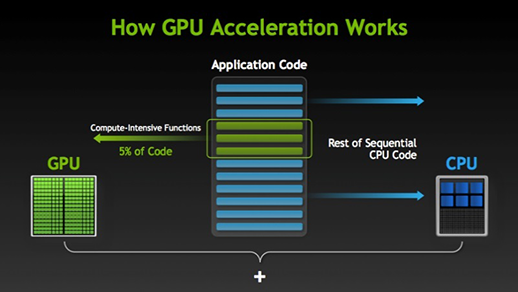
Once upon a time, database throughput and application performance were proportional to available RAM and number of CPUs. This, however, quickly changed with the rise of NVIDIA and the GPU. It's easy to think that a GPU is simply used for graphical concepts like video games, modeling, and more. The GPU industry itself is largely synonymous with the gaming industry today but it's so much more than that. To make the distinction it helps to understand how GPU acceleration works under the hood.

Source: Nvidia


GPU-accelerated computing refers to the use of a GPU together with a CPU to accelerate applications in fields such as deep learning, engineering, and analytics. It works by offloading compute-intensive portions of an application's code to a GPU while the remainder continues to run on the CPU. Furthermore, the architecture of a given GPU is very different from that of a CPU. We've all heard of "quad-core" and "octa-core" CPUs, but why don't we hear of any "octa-core" GPUs? It's because they're already far beyond that. GPUs consist of thousands of smaller, more efficient cores that are designed to handle many tasks simultaneously (read: a massively parallel architecture) (Nvidia). This architecture means that a GPU can handle copious amounts of data better than a CPU can. It's easy to see where this is headed.

Let's backtrack a bit and tackle our main question: how does Nvidia's impact on the GPU market affect AI?

The answer lies in GPU deep learning.

GPU deep learning is an advanced machine learning technique that has taken the AI and cognitive computing industries by storm. It uses neural networks (and more) to power computer vision, speech recognition (OK Google...), autonomous cars, and much more.The neural networks that drive these projects perform very complex statistical computations in attempts to find patterns in what are often incredibly large sets of data. This is where the GPU comes in. A GPU can cut the time needed to compute these computations down dramatically by increasing the overall throughput over any given amount of time. Thanks to this architecture we are able to experiment with AI techniques that simply weren't possible (or probable) prior (Forbes).

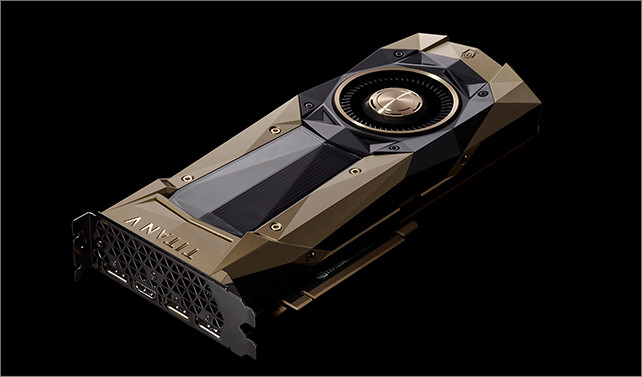
Nvidia's newest card, the Titan V, is the most powerful consumer-grade GPU ever released (Titan V Webpage). 

Source: Nvidia


Inside of it lies their new Volta architecture, which they say is the world's most advanced architecture. With 640 Tensor Cores and over 100 TeraFLOPS of performance, that's no lie; it really is the best AI-oriented card and architecture on the market. Though, at $3,000 it's a bit pricey. At least Titan users get free access to GPU-optimized deep learning software on Nvidia's GPU Cloud. How nice of them.

If you're interested, you can read the whitepaper on their Volta architecture here.
(Posted originally to Google Group on 12/16/17) 

Sunday, December 10, 2017

The Growing Safety Problem in AI

With the exponential advances in technology, specifically in artificial intelligence (A.I.), safety is becoming a major debate. There are several factors contributing to the lack of safety in A.I. One of the main reasons for this debate is competition. In an article by Ariel Conn, the lack of safety is described as a result of the race for something new and amazing, specifically in the field of A.I. Basically, countries are competing against one another for making the next technological breakthrough. The first one to make such a breakthrough will benefit greatly economically, socially, and perhaps even give them more power (military speaking). Thus, developers are not focusing on the safety and reliability of these new A.I., which causes debates on how important safety is and whether or not safety guidelines should be put into place.

Why does safety matter all that much? If the A.I. performs its given task well, why should we be concerned whether or not it's 100% safe? The answers to these questions are answered in another article written by Conn. Safety is a huge factor to market value of new and growing technologies, like cars, security systems, and even microwaves. Therefore, safety should be a huge factor in A.I. as well but there are problems with that (like the competition factor). Also, a lack of cooperation between countries in setting safety guidelines for emerging A.I. contributes to the lack of safety as well. Also, safety is more broad than one might expect. It doesn't only include physical safety but also emotional safety.
(Source: https://futureoflife.org/2017/09/21/safety-principle/)
In an article by Dave Gershgorn, a great point is mentioned. Currently, A.I. is becoming too complex and showing unexpected outcomes. Today, producers of A.I. implement machine learning (which will be talked about later in the term) and thousands of sensors in their technology. These algorithms and artificial neuron networks are very complex. The problem is A.I. will be expected to make a certain decision given a scenario but will do something completely different. Scientists have a tough time understanding their own creations. Unexpected outcomes are currently a big issue in A.I. and also explain why there is a lack of safety. It's almost impossible to predict an A.I.'s decisions; therefore, every A.I. would require very extensive safety testing in almost every situation imaginable.

Personally, I think safety in A.I. needs to be addressed as soon as possible. With the way technology is advancing, there needs to be some sort of guidelines to keep things under control. Though it might be tough to come up with such guidelines, I think it's possible and a necessity. I think that even though A.I. has many great benefits, it's not worth the risk if the A.I. isn't considered "safe". In order to encourage safety among everyone, the dangers and possible risks of A.I. need to be spread. People should be aware of these risks which might spur a change towards making safety the number one priority.

AI Remixing Sounds using Neural Networks

Photo by Denisse Leon on Unsplash

With an increased desire to use unique sounds, music producers invest a lot of money in synthesizers, virtual instruments, samplers, and recording equipment. This new sound design trend has led to the rise of some popular synthesis virtual instruments such as Serum. Serum is "a wavetable synthesizer with a truly high-quality sound, visual and creative workflow-oriented interface to make creating and altering sounds fun instead of tedious, and the ability to 'go deep' when desired - to create / import / edit / morph wavetables, and manipulate these on playback in real-time." In a fairly recent Google Magenta project, NSynth, Google was able to accomplish similar audio synthesis using neural networks.

At it's core NSynth uses neural networks to encode and decode sounds allowing artists to interpolate between multiple instruments, generating unique sounds. It differs from Serum's approach of synthesis in the fact that NSynth completely relies on neural networks instead of wavetables. The creativity of this instrument is limited to your sample library. You can try a demonstration of this in practice on the web here. My favorite combination is the Cat + Vibraphone.

While this is an incredibly cool use of neural networks to generate sounds, this project could be furthered by combining this with different sound synthesis algorithms to make far more interesting sounds. For example if NSynth was paired with granular synthesis, AI could make some pretty unique cinematic pads. Paired with FM (frequency modulation) synthesis, AI could use basic sound waves to make some very harmonic sounds that could be used for something like a dubstep or trap bass. The possibilities could be endless, and the result could be a virtual instrument that is far more powerful than Serum.

Thursday, December 7, 2017

DeepMind at it again


File:Chess-king.JPG


A recent BBC article entitled "Google's 'superhuman' DeepMind AI claims chess crown" , discuses DeepMind's recent achievements. While the title is somewhat over the top, it contains interesting information relating to what DeepMind has been up to. It's program, AlphaZero recently won in a chess competition against another AI, Stockfish. It won 75 games as white, 3 games as black, and the other 72 games were draws. This occurred after four hours of training against itself. AlphaZero has also beaten other AI in the Japanese game of Shogi, and a previous version of itself at go after similar hours of training. It seems DeepMind is after all the board game titles. As another article points out, this AlphaZero is more versatile than other programs, as it is not specialized to a specific task. However, this versatility came at a cost, as it used a massive amount of processing power, 5000 custom processors. This article really emphasizes how AlphaZero was given very little help while learning the games, merely the rules of the game, and then it trained for a ridiculously small number of hours against itself. Google hopes this will help DeepMind get closer to a general AI, to help with more complicated problems.

What most interests me about this story is that it is even a competition. Granted, almost half of the chess games were draws, but that still seems to low to me. If both AI are processing all the possible moves then both AI should never lose, and thus they would always tie. This is most true in chess, which AI has been better than humans for a long time. I would not think that having more processing power or a better algorithm would be that much of an advantage. I suppose the AI in my mind were not as strong as the AI in reality, but I think that eventually, even soon, there will be no more room to improve. The programs will be fast enough that they can explore the whole tree and expand all the states, and thus an "Ideal" game will be played, with neither making a mistake. I suppose there could even be multiple of these games. I am curious to see what these games would be, but the sport will be a little less exciting.

The other hugely interesting thing fact about this story is how AlphaZero taught itself quickly, and was not told to use cheap tricks by humans. I think this relates well to our debate which occured yesterday, where we discussed how the nature of how something is created may affect whether or not its creator is creative. I know deep mind was mentioned, specifically with some of the images that were referenced by the "yes" team, which was one of their more compelling points. Perhaps a situation like this, where the AI taught itself its strategies, is an even more compelling argument for the creativity of AI, or perhaps there is something else missing. It is difficult for me to land on one side or the other decisively, but stuff like AlphaZero seriously pushes me to the yes side.

image citation


Tuesday, December 5, 2017

AI the Future of Sales?

It is a general consensus that automation in the workplace will increase productivity level and will result in an increase in profits.  Most current AI bots are used for customer service but lack the intellectual capabilities to try to convince humans they need a product.  The goal of the new wave of the bots is to contact as many people that they see as potentially interested in a product, and then stay in contact with them until they are close to making a deal so they can pass it off to the actual sales reps(The actual sales reps are Human just to make that clear).  There are a few companies that are trying to develop a machine learning bot that can attract potential customers such as Conversica or Growbot.  Growbot is attempting to bring AI into the sales world and have established their two main goals.  "...the challenges with AI have 2 layers: the data you use for training your algorithms--and the algorithms themselves. Without the relevant training data, all of the algorithms are useless. AI researchers say that getting data is 90% effort and 10% building algorithms. Many people wonder why Tesla was the first company to introduce the autopilot feature to their cars, and the answer is quite simple: they've been collecting data from all of their cars on the road, while Google has only been collecting data from a few prototypes," (odd article title but some useful information)  For those of you not familiar with machine learning these are the blueprints you must follow, create a data set large enough to get some consistent results and continue to add data to make the machine better.  Growbot is dropping a subtle hint that they are going to be the first into the industry because they have been collecting data first.  I guess we will see how their building algorithm continues to improve their bots.  

A few side notes:

I don't know how many of you guys use Instagram, but from my experience when I search a product on my phone its only a matter of hours before Instagram is trying to advertise similar products on my timeline and I am sure that happens on other social media websites.  On the websites "About Us" tab on the Growbot website they include this statement  "Growbot is an all in one solution for driving predictable revenue growth.  With our AI based platform, anyone who needs to generate leads, from sales to marketing, can reach out to hundreds of potential customers in minutes."  Talk about spam!


Also apparently for those who are on the positive side of the debate over Will AI systems ever become conscious? "Over time, these bots "learned" that English was not the most efficient means of communication, and slowly started developing their own language to achieve their pre-programmed goal."  Their goal was to be as efficient as possible so the two bots no longer used English as their mode because it seemed less efficient


More in depth article of the two Facebook bots


Sunday, December 3, 2017

An A.I. that can build A.I.


In May 2017, Google Brain announced the creation of AutoML, an A.I. that can help them create new A.I.s. AutoML focuses on deep learning, and more specifically reinforcement learning, that involves passing data through neural network (imitating how the human brain works). We will be talking about deep learning and neural network later in the term. 

AutoML can essentially create a "child" that can perform a particular task. “In our approach, a controller neural net can propose a ‘child’ model architecture, which can then be trained and evaluated for quality on a particular task,” Google says in their Research Blog. “That feedback is then used to inform the controller how to improve its proposals for the next round. We repeat this process thousands of times — generating new architectures, testing them, and giving that feedback to the controller to learn from.” You can read more about AutoML and the details of the algorithm here. 

Last November, Google used AutoML to make NASNet, a computer vision system that has already broken the record for the most accurate image recognition, as seen in the graph below. They tested the program on the ImageNet image classification and COCO object detection data sets, which Google claims to be “two of the most respected large-scale academic data sets in computer vision” and it outperformed all other human-made systems.


Image Credit: Google Research Blog

There are a number of potential application for NASNet, some of them include faster and safer self-driving cars, facial recognition to replace passports (like in Australia) and even helping visually-impaired people to regain sight. However, on the other hand, there are also some potentially detrimental application, like robots "reproducing" so fast that humans cannot keep up. The question now becomes how do we ensure that the parent does not pass down biases to the child system and, most important, how do we make sure that the systems are used ethically. It is easy to imagine how people can take advantage of this technology for evil ends, such as recognizing faces on the street and following them. This concern seems to be so pervasive that Amazon, Facebook, Apple and other big companies have created a "Partnership on Artificial Intelligence to Benefit People and Society". The Institute of Electrical and Electronic Engineers has also created ethical standards for AI. 

In my opinion, using A.I. to help us better create A.I. is a great use of our resources. It would take us a much larger amount of time and energy to do what AutoML does so "easily". I do agree that there are a number of ethical issues at stake here and it does sound straight out of a science fiction movie. However, if researchers don't have to spend so much time on the grunt work, they will have time to perfect the systems and oversee them to make sure the biases are not passed down. Moreover, if society can recognize that A.I. technology is exponentially developing, then it should create rules and regulations right now to make sure that nothing gets out of control (which they are starting to do). All in all, I think there are more benefits than harms in this and I think it is a genius idea from Google. 

You can read more about the topic in the following links:


Woebot - a chatbot for mental health?

Image credit:  https://woebot.io/ What's old is new again!   In a modern revival of the original chatbot Eliza , the world now has.....